
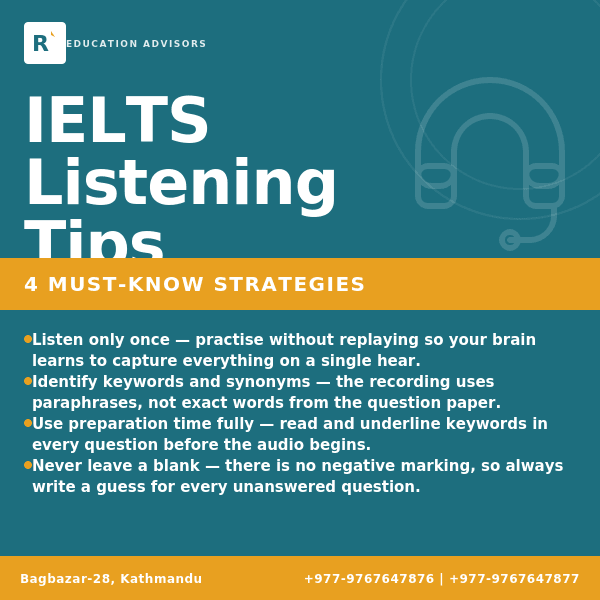
IELTS Listening Test: How to Attempt It, Strategies, Question Types and Band Score Tips (2026)
IELTS Academic & General Training · 4 sections · 40 questions · 40 minutes · Updated 2026
What is the IELTS Listening test?
The IELTS Listening test is the first of four sections in the IELTS exam and is identical for both Academic and General Training candidates. It is designed to assess how well you understand spoken English across a range of everyday and academic contexts, including different accents from the UK, USA, Australia, Canada, and other English-speaking countries.
Key facts at a glance: 4 sections · 40 questions · 30 minutes of audio + 10 minutes transfer time · Each correct answer = 1 mark · No penalty for wrong answers · Audio played only once
The IELTS Listening exam measures far more than simple hearing ability. In fact, it also tests your concentration, prediction skills, vocabulary knowledge, and your ability to identify keywords and synonyms in real time. As a result, many students underestimate this — they focus only on listening, not on the strategic skills that separate band 6 candidates from band 7.5+ candidates.
Because the audio is played only once, understanding the test format and applying the right strategies before, during, and after each section is essential. Students who understand the format usually perform much better because they know how to predict answers and avoid common mistakes.
New to IELTS altogether? Start with our IELTS basics guide before diving into section-specific strategy. If you are also preparing for the writing module, our complete Writing Task 1 guide covers the structure, vocabulary, and band descriptors you need for that section.
IELTS Listening test format — the four sections
The IELTS Listening test is divided into four sections, each containing one recording and ten questions. The sections increase in difficulty from Section 1 to Section 4. Each section has a topic and title — this title gives important clues about the upcoming questions and the type of vocabulary you should expect.
| S1 Section 1 | A conversation between two people in an everyday social context. Examples include booking a hotel room, enquiring about a university course, or discussing travel plans. This is the easiest section — the speaker talks slowly and key information is often repeated. Questions are typically form-filling or note-completion. Answers are factual: names, dates, prices, addresses, phone numbers. |
| S2 Section 2 | A monologue set in an everyday social context. Examples include a guided tour, a community announcement, or a speech about local facilities. One speaker presents information without interruption. Questions often include multiple choice, matching, or labelling a map or diagram. Direction vocabulary is important here. |
| S3 Section 3 | A conversation between up to four people in an educational or training context. Examples include students discussing an assignment with a tutor, or a group planning a research project. This section is more challenging — speakers may interrupt each other, agree, disagree, or change their minds. Watch carefully for distractors. Questions include multiple choice and matching. |
| S4 Section 4 | A monologue on an academic subject. This is the most difficult section — a university-style lecture delivered at natural speed with no pauses. There is no example at the beginning of this section. Questions are typically sentence completion or summary completion. Concentration here is critical — losing focus costs multiple marks in a row. |
Understanding the context — how to use section titles and speaker relationships
Before each section begins, you are given a brief title or introduction that hints at the topic. Use this strategically, since predicting content in advance is one of the highest-value habits you can build. If the section is about accommodation or university registration, for example, you can predict the types of information that may appear — room numbers, dates, names, fees, deadlines.
In conversation sections (Section 1 and Section 3), understanding the relationship between speakers is equally important. One speaker typically asks questions while the other provides information. As a result, recognising these patterns makes it easier to track where the answers will come from. In Section 3 especially, map speaker roles — who is the student, who is the tutor, who is providing the key facts — before the audio starts.
Key technique: Build an anticipation mindset. Before each section, predict what facts, numbers, or opinions you expect to hear based on the question patterns. This primes your brain to recognise answers the moment they are spoken.
IELTS Listening question types — strategies for each
Knowing what each question type requires — and the strategy that works best for it — means you will never be caught off guard on test day. There are seven main IELTS Listening question types:
1. Multiple choice questions
Choose the correct answer from A, B, or C (single answer) or select multiple correct options. Wrong options are frequently mentioned in the audio before the correct answer is confirmed — this is intentional. So, use the process of elimination and predict paraphrases (e.g. "main benefit" in the question may appear as "primary advantage" in the audio). Questions follow audio order.
2. Matching questions
Match a list of items — such as speakers, places, or events — to a list of descriptions or options from the recording. Preview both lists before the audio starts and anticipate synonyms. Then, track the conversation flow carefully and cross out options as they are used to narrow down remaining answers.
3. Form, note, table and flow-chart completion
Fill in gaps using exact words or short phrases directly from the audio. Always check the word limit in the instruction — "no more than two words" means exactly that. Predict the type of answer expected from the context: a name, number, date, or place. These questions typically appear in Section 1 and require factual accuracy.
4. Sentence completion
Complete sentences using information from the recording. Focus on both grammatical fit and meaning — your completed sentence must be grammatically correct. Listen for paraphrased ideas around the keywords you have underlined before the audio starts.
5. Short answer questions
Write brief answers of one to three words directly from the recording. Stick strictly to the word limit in the instruction. Listen for factual details signalled by the keywords in the question.
6. Plan, map and diagram labelling
Label locations or parts on a visual using words from the recording. Practise direction and position vocabulary before the exam: left, right, north, south, opposite, next to, adjacent to, between. Follow spatial descriptions carefully and track your position on the visual as the speaker moves through it.
7. Summary completion
Complete a summary paragraph using words from the recording or from a given word list. This type often appears in Section 4 alongside an academic lecture. So, focus on understanding the overall meaning of each sentence before the audio plays so you can identify where the answer fits.
Identifying keywords and synonyms — the most important IELTS Listening skill
This is the skill that separates band 6 candidates from band 7.5+ candidates. The IELTS Listening recording almost never uses the exact same words that appear in the question paper. Instead, speakers use synonyms and paraphrasing. Consequently, a student who only listens for exact words will miss a significant number of answers.
Common synonym examples in IELTS Listening
repair → fix · restore
important → crucial · essential · key
increase → rise · grow · expand
decrease → fall · drop · reduce
like → enjoy · prefer · be fond of
disagree → oppose · have a different view
problem → issue · challenge · difficulty
start → begin · commence · launch
cancel → call off · withdraw
available → free · open · vacant
depart → leave · set off
arrive → reach · get to
submit → hand in · turn in
deadline → due date · cut-off
grade → mark · score · result
lecture → talk · presentation · class
Step-by-step technique for mastering keywords and synonyms
- Before the recording: Underline the main keywords in each question and quickly brainstorm one or two possible synonyms for each.
- During listening: Focus on meaning and context rather than exact word matches. When you hear a synonym of your keyword, that signals the answer is coming.
- After practice tests: Review the audio transcript alongside your answers. Note every paraphrase that tricked you and build a personal synonym bank over time.
- Segmented practice: Play short 10–20 second clips, pause, and summarise the key information in your own words. This develops active listening and improves synonym recognition speed.
Practice resource tip: After every IELTS Listening practice test, always review the transcript and audio script. Understanding why you missed an answer is more valuable than simply noting that you got it wrong.
Developing multitasking skills for the IELTS Listening test
The IELTS Listening test requires you to juggle three tasks simultaneously: recognising keywords and synonyms to predict answers, actively listening for details and context, and writing answers while tracking the audio. Naturally, most candidates struggle with this coordination, especially in Sections 3 and 4 where the pace increases significantly.
Proven multitasking strategies
Use the preview technique
Read the next question while the current one is being narrated. This keeps your brain prepared for upcoming information and prevents you from falling behind the audio.
Train with distractions
Occasionally practise listening in a slightly noisy environment to sharpen your focus, since the exam hall will not be silent — other candidates turning pages and writing can break concentration.
Create mental mind maps
Before the audio starts, visually link the keywords in your questions to their likely topic area. This helps you stay organised when the audio moves quickly between ideas.
Practice under real exam conditions
Complete full IELTS Listening practice tests without pausing the audio. Many students pause during practice and then struggle in the real exam. Official practice tests from British Council, Cambridge IELTS, and IDP are the most reliable resources.
How to attempt the IELTS Listening test — step by step
Before the audio starts
- Read the questions carefully. Use every second of preparation time — identify key words, understand what information you are listening for, and predict the type of answer expected (a number, a name, a place).
- Underline keywords in the questions. Focus on nouns, numbers, and names. Be prepared to hear synonyms or paraphrases rather than the exact words from the question.
- Predict possible answers. Based on the question context, guess what kind of answer might appear. This primes your brain to recognise the answer when it is spoken.
While the audio is playing
- Follow the order. Answers always appear in the same order as the questions. If you miss one, move on immediately.
- Write as you listen. Write answers on the question paper as you hear them. You will have time at the end to transfer them to the answer sheet.
- Watch for distractors. Speakers often mention a wrong answer before correcting it. For example: "We could meet at 3pm — actually, let's make it 4pm." The answer is 4pm, not 3pm. This distractor technique is especially common in Section 3.
- Shift attention forward. Then, once you have written an answer, immediately move your focus to the next question.
After the audio ends — transfer time
- Transfer carefully. Paper-based candidates have 10 minutes; computer-based candidates have 2 minutes. Double-check that each answer is in the correct numbered box.
- Check spelling on every answer. A correctly heard answer written with a spelling mistake is marked zero. Pay special attention to names, places, and numbers written as words.
- Attempt every question. There is no penalty for incorrect answers. Never leave a blank — always write a guess.
Top 10 tips to improve your IELTS Listening score
Preparation and In-Test Habits
Practise with the audio playing only once
However, many students replay recordings during practice. In the real exam you hear each section only once — train your ear from the start to capture information on a single listen.
Get comfortable with different accents
The IELTS Listening test features British, American, Australian, Canadian, and other English accents. Expose yourself through podcasts, BBC World Service, CNN, ABC Australia, and TV shows from different English-speaking countries.
Always use preparation time fully
The preparation time before each section is one of your biggest advantages. Use every second to read questions, underline keywords, and predict answers.
Follow word limits strictly
If a question says "no more than two words", writing three words — even if correct — earns zero marks. Always read the instruction carefully before answering.
Listen for synonyms, not exact words
Train yourself to recognise meaning rather than match exact phrases. The question may say "cost" but the speaker says "price" or "fee". Build a synonym bank through regular transcript review.
Review and Test-Day Habits
Watch out for plural answers
If the correct answer is plural ("documents") and you write singular ("document"), your answer will be marked incorrect. Listen carefully for plurals and articles.
Do not panic if you miss an answer
Move immediately to the next question. Panicking about one missed answer causes you to miss the next two or three. A single missed answer costs one mark — losing concentration costs far more.
Review every practice test with the transcript
After each free IELTS Listening practice test, go through the audio script and identify exactly where you went wrong — a missed keyword, an unrecognised synonym, or a spelling error. This transforms practice into targeted improvement.
Check spelling carefully during transfer time
Use the 10-minute transfer window to review every answer for spelling. Common problem words include names, places, and numbers written as words.
Always guess unanswered questions
There is no negative marking in IELTS Listening. A blank is guaranteed zero. A guess has a chance of being correct. Never submit an empty box.
Common mistakes to avoid in IELTS Listening
Mistakes During the Test
Not reading questions before the audio starts
Many candidates listen passively without knowing what information to focus on. Always use preparation time to read questions and predict answers.
Writing the distractor answer
Speakers often mention incorrect information before correcting it. As a result, writing the first thing you hear rather than the final confirmed answer loses the mark every time.
Waiting for exact word matches
If you only listen for the exact words in the question, you will miss answers that are expressed through synonyms or paraphrasing — which is how most answers are delivered.
Ignoring the word limit
Writing more words than allowed — even if all correct — results in zero for that question. Always check the instruction first.
Mistakes During Review and Transfer
Spelling errors on the answer sheet
Incorrect spelling means the answer is marked wrong regardless of meaning. Pay special attention when transferring answers under time pressure.
Losing concentration in Section 4
Section 4 is a fast-paced academic lecture with no example and no pause. Candidates who have not practised extended academic listening often drop several marks here in a row.
Leaving answers blank
There is no penalty for wrong answers. A blank is always zero. Guess every unanswered question before transfer time ends.
Official IELTS Listening practice tests and preparation resources
Official IELTS Listening practice tests are one of the most effective preparation tools available. They use real exam recordings, genuine question types, and accurate band score conversions. The most reliable sources are:
- British Council — Free practice tests and preparation materials at britishcouncil.org
- IDP IELTS — Official practice tests and mock exams at ielts.org
- Cambridge IELTS books — The Cambridge IELTS series (books 1–18) contains authentic past papers and is widely considered the gold standard for practice material
After each practice test, review your mistakes carefully by asking these questions:
- Did I miss a keyword in the question?
- Did I fail to recognise a synonym in the audio?
- Did I ignore the word limit?
- Did I make a spelling mistake on the answer sheet?
- Did I lose concentration and miss multiple questions in a row?
Ultimately, this type of structured review transforms free IELTS Listening practice tests from a measurement tool into a genuine learning opportunity. So, students who review every error consistently improve by one to two bands within 6–8 weeks.
IELTS Listening band score and raw score conversion
Your raw score — the total number of correct answers out of 40 — is converted to an IELTS band score between 1 and 9. For a full breakdown of what each band level demonstrates across all four skills, see our guide to IELTS band descriptors. Here is the standard conversion table used by British Council and IDP:
| Raw Score (out of 40) | Band Score |
|---|---|
| 39–40 | 9.0 |
| 37–38 | 8.5 |
| 35–36 | 8.0 |
| 32–34 | 7.5 |
| 30–31 | 7.0 |
| 26–29 | 6.5 |
| 23–25 | 6.0 |
| 18–22 | 5.5 |
| 16–17 | 5.0 |
| 13–15 | 4.5 |
| 10–12 | 4.0 |
To reach band 7.0 in Listening you need at least 30 correct answers out of 40. To reach band 8.0, you need at least 35. Therefore, the fastest route to improvement is eliminating careless errors — spelling mistakes, distractor answers, and word limit violations — before trying to improve your general English level.