
IELTS Listening Test Format: A Beginner's Guide
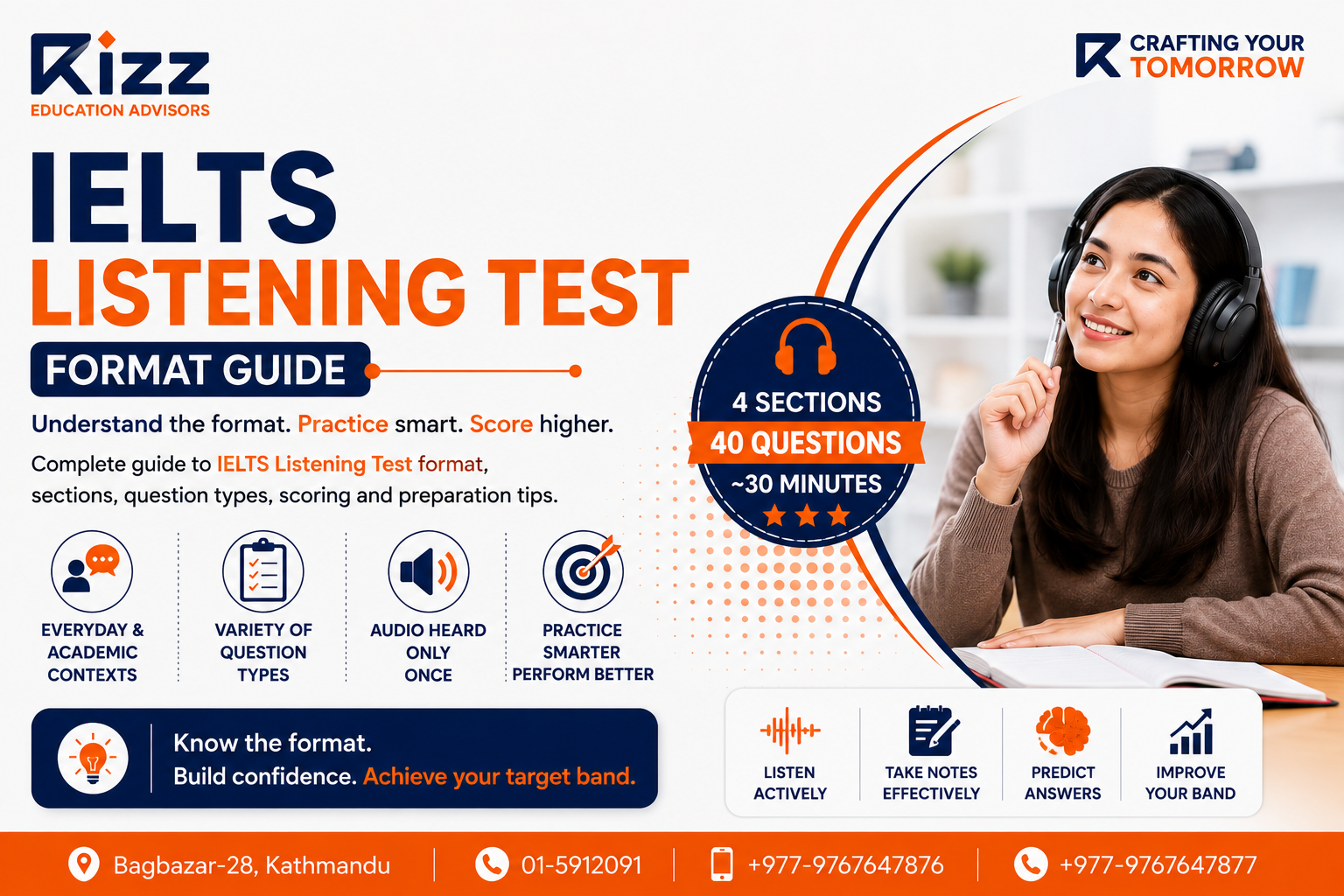
The IELTS Listening Test is one of the four sections of IELTS. It assesses how well you understand spoken English in everyday, educational and academic situations. The IELTS Listening Test format has four parts and 40 questions. You hear each recording once, so understanding the format before you practise can help you follow the recording, predict answers and avoid common mistakes.
What Is the IELTS Listening Test?
The Listening test is the same for IELTS Academic and IELTS General Training. You listen to four recorded conversations or monologues and answer 40 questions. The questions generally follow the order of the information in the recording, so the information for an earlier question normally comes before the information for a later question.
Different English accents are used, including British, Australian, New Zealand and North American accents. Therefore, regular practice with different speakers can help you become more comfortable with natural English.
IELTS Listening Test Format at a Glance
| Feature | IELTS Listening |
|---|---|
| Number of parts | 4 |
| Number of questions | 40 |
| Questions per part | 10 |
| Listening time | Approximately 30 minutes |
| Recordings | Heard once only |
| Marks | 1 mark for each correct answer |
| Final result | IELTS band score from 1 to 9 |
For the paper-based test, you have 10 minutes at the end to transfer your answers to the answer sheet. Check the instructions carefully because spelling and word limits can affect your marks.
What Happens in the Four IELTS Listening Parts?
Part 1: Everyday Conversation
Part 1 is a conversation between two people in an everyday social situation. For example, they may discuss travel arrangements, accommodation, an appointment or another practical matter.
Part 2: Everyday Monologue
Part 2 is a single speaker talking about an everyday social situation. The topic may involve local facilities, services or another familiar setting.
Part 3: Educational Discussion
Part 3 involves a conversation in an educational or training context. You may hear students discussing an assignment, research project or course-related topic, sometimes with a tutor.
Part 4: Academic Monologue
Part 4 is a single speaker talking about an academic subject. The information is usually presented in a lecture-style format, so concentration and note-taking become particularly important.
IELTS Listening Question Types
The Listening test uses several question formats. Knowing what each format requires helps you use your preparation time effectively.
Multiple Choice
You choose the correct answer from the options provided. Read the options before the recording reaches the relevant information and listen carefully because the speaker may mention more than one option before giving the correct answer.
Matching
You match information from the recording with a list of options. Focus on meaning rather than waiting for the exact words from the question.
Plan, Map or Diagram Labelling
You identify locations, features or parts of a diagram based on the speaker's description. Pay attention to direction words, landmarks and the starting point.
Form, Note, Table or Flow-Chart Completion
You complete missing information from the recording. Always check the word limit before writing an answer.
Sentence Completion
You complete sentences using information from the recording. Read the sentence first so you can predict what type of word or information is needed.
Short-Answer Questions
You answer a question using information from the recording. Follow the stated word limit and check spelling before moving on.
For a deeper guide to question types and strategies, read our complete IELTS Listening test strategies and question types guide .
What Skills Does the IELTS Listening Test Assess?
The test requires more than simply recognising English words. You need to understand the main idea, identify specific information, follow a discussion and recognise changes in what a speaker says.
You also need to manage your attention while reading questions and listening at the same time. As a result, practice should include prediction, concentration, spelling and recognition of synonyms.
How to Prepare for the IELTS Listening Test
Read the Questions Before the Recording
Use the available preparation time to understand each question. Identify the important words and predict what information you need to hear.
Listen for Meaning, Not Only Exact Words
The speaker may use a synonym or paraphrase instead of repeating the words in the question. Therefore, focus on the meaning of the sentence and the information you need.
Practise Different English Accents
Include different English accents in your practice. This helps you become less dependent on one familiar pronunciation and prepares you for a wider range of speakers.
Improve Spelling and Word Limits
A correct idea can still lose a mark if the answer is misspelled or exceeds the stated word limit. Check these details every time you practise.
Review Every Practice Test
Do not only count your correct answers. After each practice test, identify why you missed an answer. Then check whether the problem was vocabulary, concentration, spelling, prediction or failure to follow the recording.
Common IELTS Listening Mistakes
- Trying to remember every word instead of listening for the required information.
- Waiting for the exact wording from the question.
- Spending too much time on an answer that has already been missed.
- Ignoring the word limit in completion questions.
- Writing an answer without checking spelling.
- Failing to predict the type of answer before the recording begins.
- Practising only with one English accent.
If you miss one answer, move on and focus on the next question. The recording continues, so losing concentration for several questions can create a larger problem than missing one answer.
IELTS Listening Band Score
You receive one mark for each correct answer. Your raw score out of 40 is converted into an IELTS Listening band score. The exact conversion can vary slightly between test versions, so use official scoring information when checking a target score.
For practice, focus on improving the number of correct answers rather than trying to memorise one fixed conversion table.
Official IELTS Listening Practice Resources
Once you understand the format, practise with official materials so that you become familiar with the task types and test conditions.
Frequently Asked Questions About IELTS Listening
How many questions are in the IELTS Listening Test?
There are 40 questions divided into four parts, with 10 questions in each part.
How long is the IELTS Listening Test?
The Listening section takes approximately 30 minutes. For the paper-based test, you also receive 10 minutes to transfer your answers to the answer sheet.
Is IELTS Listening the same for Academic and General Training?
Yes. The Listening test is the same for IELTS Academic and IELTS General Training.
Can I hear the recording twice?
No. In the standard IELTS Listening test, each recording is played once only. Therefore, your practice should include tests where you listen only once.
How can I improve my IELTS Listening score?
Use timed practice, learn the question formats, predict answers, listen for paraphrases, practise different accents and review every mistake after each test.
Conclusion
Understanding the IELTS Listening Test format is the first step towards effective preparation. Learn the four parts, become familiar with the question types and practise listening only once. Most importantly, review your mistakes after every practice test so that each session improves a specific skill.
If you are preparing for other IELTS sections, you can also read our guides to IELTS Speaking test questions and IELTS Writing Task 1 sentence structures .
If your IELTS preparation is connected to a UK study plan, see our guide to study in the UK from Nepal requirements .

How to Score Band 9 in Listening Test?
Improving your IELTS Listening skills requires consistent practice and strategic techniques. Here are some advanced methods to enhance your listening ability:
1. Exposure to Different Accents
Listening to authentic English from different regions will help you become familiar with various accents and speech patterns. Regularly listen to national news broadcasters from the following English-speaking countries:
- UK – BBC News
- USA – CNN
- Canada – CBC News
- New Zealand – TVNZ
- Australia – 9News
Advanced Strategies:
- Try shadowing: Listen to a sentence and repeat it simultaneously. This will improve your comprehension and pronunciation.
- Accent identification drills: Listen to speakers from different regions and try to guess their accent.
- Transcription practice: Listen to a short clip, write down what you hear, and compare it to the actual transcript.
- Speed variation: Adjust playback speed on YouTube or podcasts to challenge your listening skills.
- Listen with subtitles first, then without: This helps you associate words with their sounds before testing pure listening skills.
2. Practice with Cambridge IELTS Materials
Cambridge publishes official IELTS practice books annually. You can find past test recordings on YouTube by searching for:
- “IELTS Cambridge Listening Test 1-19” (Each book contains four tests: Test 1, Test 2, Test 3, and Test 4)
Expert Strategies:
- Use Predictive Listening: Before playing the recording, look at the questions and try to predict the type of words (noun, verb, number) that might fit the blanks.
- Active Note-taking: Use abbreviations and symbols to jot down important points while listening.
- Time-stamped analysis: After completing a test, go back and analyze at what exact time the answers were mentioned.
3. Mastering Multi-Tasking
Listening in IELTS requires you to listen, comprehend, and write answers simultaneously. Focus on improving the following skills:
- Processing speed: How quickly can you understand the meaning while listening?
- Writing efficiency: Can you write answers accurately while listening?
- Keyword recognition: How well can you identify keywords and their synonyms?
Step-by-Step Technique:
Don’t hurry yourself on writing answers initially. Conduct following activities for every attempt of listening,
- First Listening: Focus only on understanding the context without writing answer.
- Second Time: Listen again and note down key points.
- Third Attempt: Take a full test under timed conditions.
- Summarization Practice: After each listening test, summarize the main idea of each section in 5 to 7 sentences.