
IELTS Writing Task 2 Band Scores: The Complete Guide (Band 4.5 to 9.0 Explained)
Introduction: Why Understanding Band Scores Changes Everything
Most IELTS candidates know their target band score. Very few understand what that band score actually looks like on the page — meaning what kind of sentences, what level of vocabulary, what degree of accuracy an examiner expects to see before awarding it.
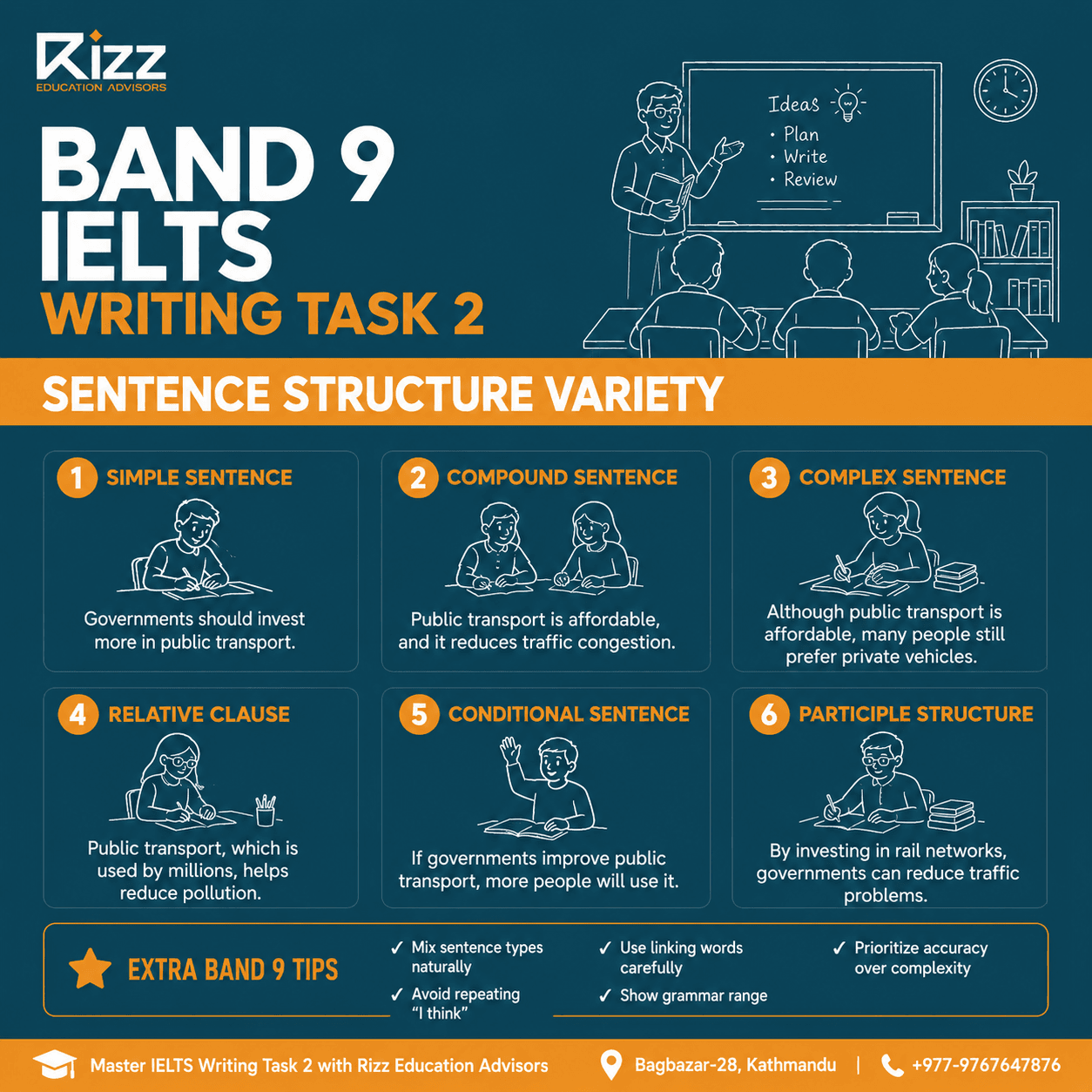
This guide fixes that. It shows you, with real side-by-side examples, exactly what writing looks like at Band 4.5, 5, 6, 7, 8, and 9 — focusing specifically on sentence structure variety, the most directly trainable component of Grammatical Range and Accuracy. It also covers the precise difference between Band 8 and Band 9, the most common mistakes at every level, and a quick reference pairing every official descriptor with a real sentence.
Whether you are at Band 5 trying to reach 6.5, or at Band 7.5 chasing Band 9 — this is the guide that maps the distance.
What Is IELTS Writing Task 2?
IELTS Writing Task 2 is a formal academic essay of at least 250 words, completed in approximately 40 minutes. It carries two-thirds of the total Writing section mark, making it the single most important writing task in the test.
Every Task 2 essay is assessed across four equally weighted criteria, each worth 25%:
| Criterion | Short Form | What It Measures |
|---|---|---|
| Task Response | TR | Did you answer the whole question with extended, relevant, supported ideas? |
| Coherence and Cohesion | CC | Does your essay flow logically? Are ideas and paragraphs linked naturally? |
| Lexical Resource | LR | Do you use a wide, precise, and natural range of vocabulary? |
| Grammatical Range and Accuracy | GRA | Do you use a variety of sentence structures accurately and flexibly? |
This guide focuses most heavily on Grammatical Range and Accuracy (GRA) — specifically sentence structure variety — because it is the criterion most directly improved through deliberate, pattern-based practice.
There Is No Pass or Fail in IELTS
IELTS does not have a pass or fail result. Every test-taker receives a band score between 1 and 9 that describes their current English proficiency level. Whether that level meets your specific purpose — university admission, immigration, professional registration — depends on the minimum requirement of that institution or authority.
| Band | CEFR Level | Global Descriptor |
|---|---|---|
| 9.0 | C2 | Expert User |
| 8.0–8.5 | C2 / C1+ | Very Good User |
| 7.0–7.5 | C1 | Good User |
| 6.0–6.5 | B2 | Competent User |
| 5.0–5.5 | B1–B2 | Modest User |
| 4.5 | B1 | Limited User |
| Below 4.0 | A1–A2 | Basic / Extremely Limited User |
The Official GRA Band Descriptors: The Examiner's Exact Standard
| Band | Official GRA Descriptor |
|---|---|
| 9 | Uses a wide range of structures with full flexibility and accuracy; rare errors occur only as slips |
| 8 | Uses a wide range of structures; makes only very occasional errors or inappropriacies |
| 7 | Uses a variety of complex structures; produces frequent error-free sentences; errors rarely reduce communication |
| 6 | Uses a mix of simple and complex sentence forms; errors rarely reduce communication |
| 5 | Uses only a limited range of structures; attempts complexity but these tend to be less accurate than simple sentences |
| 4.5 | Uses only a very limited range; errors are frequent and may cause difficulty for the reader |
The progression from Band 5 upward is always the same: more variety + fewer errors + greater complexity used accurately. At Band 9, structure must be not just accurate but flexible — chosen because it best serves the argument, not because it signals grammar knowledge.
Sentence Structure at Every Band Level: Side-by-Side Examples
The same idea — governments should invest in public transport to reduce traffic congestion — is expressed below at each band level. Reading these in order reveals exactly how language changes as band scores rise.
❌ Band 4.5 — Very Limited Structures, Frequent Errors
Government should invest in public transport. It can reduce traffic. Traffic is big problem in city. Many people use cars. This is bad.
What the examiner sees:
- Five identical simple S + V + O sentences throughout
- Missing article: "Government should" → should be "The government"
- Missing article: "Traffic is big problem" → "a big problem"
- Vague vocabulary: "bad," "big problem" — no academic register
- No subordinate clause, no linker, no cohesion whatsoever
→ Caps GRA at Band 4.5
⚠️ Band 5 — Limited Range, Attempts at Complexity That Often Fail
Governments should invest in public transport because traffic congestion is a big problem. Although public transport is good, but many people still prefer cars. This is why governments need to take action.
What the examiner sees:
- Attempts a causal clause ("because") — positive signal
- Critical error: "Although...but" — a double conjunction; a systematic structural mistake
- Vocabulary limited: "big problem," "take action," "good"
- "This is why" used mechanically — weak cohesion
→ Caps GRA at Band 5
✅ Band 6 — Mix of Simple and Complex, Errors Present But Meaning Clear
Governments should invest more money in public transport systems, which would encourage people to use buses and trains rather than private cars. While this requires significant funding, the long-term benefits of reducing congestion and pollution make it a worthwhile policy.
What the examiner sees:
- Relative clause used correctly: "which would encourage..."
- Concessive clause used correctly: "While this requires..."
- Improved vocabulary: "significant funding," "long-term benefits," "worthwhile policy"
- However, both sentences follow a similar structure — limited real variety
- No conditionals, participial phrases, or comparison structures
→ Band 6 — correct but structurally limited
✅ Band 7 — Variety of Complex Structures, Frequent Error-Free Sentences
When governments invest strategically in integrated public transport networks, commuters are far more likely to abandon private vehicles, resulting in measurable reductions in both traffic congestion and urban air pollution. While critics argue that such infrastructure demands prohibitive upfront costs, the economic gains from reduced road maintenance, lower healthcare burdens, and improved productivity consistently outweigh the initial expenditure.
What the examiner sees:
- Time clause opener: "When governments invest..."
- Participial phrase: "resulting in measurable reductions..."
- Concessive clause with evaluative adverb: "While critics argue..."
- List within a clause: "road maintenance, lower healthcare burdens, and improved productivity"
- Two structurally different sentences, both largely error-free
→ Solid Band 7 — variety present and mostly accurate
✅✅ Band 8 — Wide Range, Very Occasional Errors, Flexible Control
Compared to the piecemeal road-widening schemes that have dominated urban planning for decades, sustained investment in multimodal public transport systems addresses the root causes of congestion rather than merely displacing it. By subsidising fares and expanding networks into underserved areas, governments can simultaneously reduce private car dependency, lower per-capita carbon emissions, and narrow the mobility gap between wealthier and poorer communities — three outcomes that no road infrastructure project has ever delivered simultaneously.
What the examiner sees:
- Comparison opener: "Compared to the piecemeal road-widening schemes..."
- Embedded relative clause: "that have dominated urban planning for decades"
- "By + gerund" opener: "By subsidising fares and expanding networks..."
- Parallel infinitive series: "reduce...lower...narrow"
- Em dash for stylistic emphasis followed by a summarising noun phrase
- Near-perfect accuracy with full structural variety
→ Band 8 — wide range, near-perfect accuracy, confident control
✅✅✅ Band 9 — Full Flexibility, Errors Only as Slips, Completely Natural
Just as no city in history has solved its congestion problem by building more roads, no government today can credibly claim to be addressing the climate crisis while simultaneously subsidising the private car use that accounts for approximately one-fifth of global carbon emissions. Were policymakers to redirect even a fraction of the funding currently allocated to road expansion toward genuinely integrated, affordable, and accessible public transport, the resulting shift in commuter behaviour would not only reduce emissions measurably but would fundamentally alter the spatial logic by which modern cities are designed — a transformation far more consequential than any incremental emissions target.
What the examiner sees:
- "Just as...no" parallelism — sophisticated comparative opener
- Inverted conditional (formal register): "Were policymakers to redirect..."
- Correlative conjunction: "not only...but would also fundamentally alter..."
- Abstract compound noun phrase: "the spatial logic by which modern cities are designed"
- Every structure serves the argument rhetorically — not to display grammar
- Zero systematic errors — entirely natural academic English
→ Band 9 — language is invisible; only the argument is visible
The Exact Difference Between Band 8 and Band 9
This is the most misunderstood distinction in IELTS Writing preparation. Many candidates believe Band 9 is simply Band 8 with zero errors. That is partially true — but it misses the deeper difference.
| Feature | Band 8 | Band 9 |
|---|---|---|
| Error frequency | Very occasional errors | Errors only as accidental slips — not systematic |
| Structure variety | Wide range, used confidently | Wide range, used flexibly — structure chosen to serve meaning |
| Cohesion | Accurate use of cohesive devices | Cohesion is invisible — no device attracts attention |
| Naturalness | Reads like a very proficient non-native writer | Reads like a native academic writer — indistinguishable |
| Vocabulary | Skilled, precise, fluent | Sophisticated and nuanced — word choice elevates meaning |
The single word that separates Band 8 from Band 9 in the official descriptor is "flexibility." A Band 8 writer uses complex structures well. A Band 9 writer selects which structure to use because it best expresses the specific idea being argued.
Direct Comparison — Same Topic, Two Band Levels
Topic: The impact of social media on political opinion
🔵 Band 8:
"Social media has undoubtedly transformed political communication, giving ordinary citizens a platform to express their views; however, it has also enabled the rapid spread of misinformation, meaning that its overall influence on democratic processes is deeply ambiguous."
Structures used: participial phrase, semicolon + conjunctive adverb, participial phrase. Accurate and varied — but structural choices follow a familiar template.
🟢 Band 9:
"While social media has democratised political discourse in ways that traditional broadcast media never could, it has simultaneously created an environment in which algorithmic amplification rewards outrage over accuracy — a structural bias that has arguably done more damage to informed democratic participation than any deliberate disinformation campaign."
Structures used: "while" contrast + embedded relative clause + dash-introduced noun phrase + comparative. Every choice serves the specific paradox being argued — that is flexibility.
11 Sentence Structure Patterns for Band 8–9 IELTS Writing
Use 5–6 of these across a single essay to demonstrate the wide range and flexibility that Bands 8–9 require.
Pattern 1 — When S + V + O, S1 + V1 + O1
Purpose: Show a consequence or condition and its result
When a language dies out, a whole way of life disappears with it — including oral traditions, cultural rituals, and centuries of accumulated ecological knowledge that no written archive can fully preserve.
Pattern 2 — While S + V + O, S1 + V1 + O1
Purpose: Contrast two related ideas within one sentence
While some students drop out after a few years of studying, others finish academic courses with poor degrees, suggesting that access to education alone does not guarantee meaningful outcomes for individuals or society.
Pattern 3 — S + V + O, resulting in + noun phrase
Purpose: Express a cause and its immediate, measurable effect
Many people in the countryside migrate into big cities, resulting in extreme pressure on natural resources and a rapid deterioration of affordable housing and urban infrastructure.
Pattern 4 — S + V + O, giving rise to + noun phrase
Purpose: Show a longer-term or broader consequence
Mass advertising gives consumers more choices on what to buy, giving rise to a consumer society in which personal identity is increasingly defined by purchasing power rather than shared values.
Pattern 5 — By + V-ing + Object, S + V + O
Purpose: State a method and its outcome simultaneously
By spending money to protect minority languages, governments can also preserve the traditions, customs, and behaviours embedded within them — cultural assets that no museum exhibit could adequately capture.
Pattern 6 — S + V + O, and this + V + O
Purpose: Build logically from a statement to its implication — avoids mechanical connectives
The use of private cars is increasing rapidly across most developing cities, and this puts enormous strain on existing transportation infrastructure while simultaneously degrading air quality for entire urban populations.
Pattern 7 — Instead of + V-ing + Object, S + V + O
Purpose: Propose an alternative; contrast the wrong approach with the right one
Instead of driving private vehicles to work, commuters should use integrated public transport systems that reduce both per-capita carbon emissions and chronic urban congestion.
Pattern 8 — S + V + O. This allows / encourages + smb + to do smth
Purpose: Develop a point naturally across two sentences without mechanical linking words
The utilisation of renewable energy reduces a nation's dependence on imported fossil fuels. This encourages greater energy independence and insulates economies from the volatility of global oil markets.
Pattern 9 — Compared to those who + V, S + V + O
Purpose: Draw a comparison that directly supports your argument
Compared to those who hold only high school qualifications, university graduates typically access a significantly wider range of employment opportunities, higher lifetime earnings, and greater long-term career mobility.
Pattern 10 — If S + V + O, S + V + O (conditional)
Purpose: Explore hypothetical consequences — signals sophisticated argument development
If air travel were significantly restricted through carbon taxation or regulatory caps, passengers would opt for alternative means of transport such as high-speed rail, potentially reducing aviation's contribution to global carbon emissions by a measurable margin.
Pattern 11 — S + V + O [that S1 + V1 + O1], because S2 + V2 + O2
Purpose: State a nuanced position and immediately justify it — ideal for thesis sentences
I partially disagree with the idea that advertising has negatively influenced our lives because I recognise several tangible benefits it brings to society — including funding free media, driving competitive pricing, and accelerating product innovation that serves consumer needs.
Common Mistakes That Prevent Band 7, 8, and 9
Mistakes That Cap You at Band 5–6
| Mistake | Why It Hurts | Correction |
|---|---|---|
| Every sentence is simple S + V + O | Zero structural range — cannot reach Band 7 | Add one subordinate clause per paragraph until it becomes natural |
| "Although...but" double conjunction | A systematic structural error — signals Band 5 | Use either "Although X, Y" or "X, but Y" — never both together |
| Starting every sentence with "The" | Signals monotonous, formulaic writing | Vary openers: adverbial clauses, gerund phrases, comparison structures |
| Missing comma after introductory clause | Frequent punctuation errors cap GRA at Band 6 | Always place a comma after any introductory clause: When X happens, Y occurs |
| Using complex structures that contain errors | An inaccurate complex sentence is worse than an accurate simple one | Master one new structure at a time before adding another |
Mistakes That Cap You at Band 7
| Mistake | Why It Hurts | Correction |
|---|---|---|
| Using the same 2–3 complex structures repeatedly | Range is not truly "wide" — cannot reach Band 8 | Rotate through at least 5 different structure types per essay |
| "Firstly...Moreover...Furthermore...In conclusion" every paragraph | Reads as a template, not natural academic writing | Replace at least two with pronoun reference, demonstratives, or participial phrases |
| Errors in verb form after modal verbs | "They must to study" / "She should studying" — very common | Modals always take bare infinitive: must study, should invest, can reduce |
| Incorrect article use (a / an / the) | Systematic article errors cap GRA at Band 7 | First mention = "a/an"; second mention = "the"; general statements = no article |
| Vague complex sentences | Correct structure but imprecise meaning — cannot score Band 8 | Every clause must carry a specific, defined meaning |
Mistakes That Prevent Band 9 (Keeping You at Band 8)
| Mistake | Why It Hurts | Correction |
|---|---|---|
| Occasional systematic errors (not slips) | Band 9 allows genuine accidental slips — not recurring patterns | Identify your 2–3 most frequent error types and eliminate them specifically |
| Complex structures used formulaically | Structures chosen to display grammar rather than serve meaning | Ask: does this structure help me express this idea better? If not, simplify |
| Memorised phrases that sound slightly unnatural | Examiners detect and penalise "apparently memorised phrases" | Produce fresh language anchored to the specific prompt — always paraphrase and adapt |
| Cohesive devices that attract attention | "In conclusion, it is clear that..." announces itself as scaffolding | At Band 9, the logic of the argument is the cohesion — transitions should be invisible |
| Collocation errors in sophisticated sentences | "Make a research," "rise an issue" — a single collocation error breaks the Band 9 impression | Learn vocabulary in collocations: conduct research, raise an issue, mounting challenges |
Expanded Quick Reference: All 4 Criteria With Descriptors and Example Sentences
Grammatical Range and Accuracy (GRA)
| Band | Official Descriptor | Example Sentence |
|---|---|---|
| 9 | Wide range; full flexibility and accuracy; only slips | Were governments to introduce universal basic income as a buffer against technological unemployment, societies would gain the breathing space needed to retrain workers — not as a concession to automation, but as a recognition that human labour has always adapted, and will again. |
| 8 | Wide range; very occasional errors; majority error-free | By investing in reskilling programmes targeted at industries most vulnerable to automation, governments can transform a potential crisis of structural unemployment into an opportunity to build a higher-skilled, better-compensated workforce. |
| 7 | Variety of complex structures; frequent error-free sentences | Although automation threatens many low-skilled jobs, it also creates new roles in areas such as software development and data analysis, which suggests that the net impact on employment may be more nuanced than initial predictions indicate. |
| 6 | Mix of simple and complex; errors but meaning clear | Technology is changing the job market in many ways. While some jobs are lost due to automation, new types of jobs are also created. However, workers need to be retrained, which can take a long time. |
| 5 | Limited range; complexity attempts tend to contain errors | Technology has changed jobs a lot. Although many jobs lose because of machines but workers can learn new skills. Government should help people who lose their work. |
| 4.5 | Very limited range; frequent errors may cause difficulty | Technology is bad for jobs. Many people lose job. Machines do the work of people. This is problem for the economy. |
Task Response (TR)
| Band | Official Descriptor | What This Looks Like in Practice |
|---|---|---|
| 9 | Fully addresses all parts; fully developed; consistent position throughout | Every part of the question answered; every main idea extended with a developed explanation or example; position maintained without contradiction throughout |
| 8 | Sufficiently addresses all parts; well-developed; only minor lapses | All question parts covered with strong reasoning; one argument may be slightly less developed than the others |
| 7 | Addresses all parts but some more fully than others | Both sides addressed; one body paragraph noticeably thinner; conclusion slightly repetitive of introduction |
| 6 | Generally addresses task; position may shift; some ideas not extended | Main position clear but one part of the question may be missed; ideas stated but not always explained or supported |
| 5 | Addresses task only partially | Discusses the topic generally without engaging with the specific instruction (evaluate, compare, propose) |
| 4.5 | Minimal coverage; ideas underdeveloped or irrelevant | Only one element addressed; ideas listed rather than developed; may include off-topic content |
Coherence and Cohesion (CC)
| Band | Official Descriptor | Example Sentence Demonstrating This Level |
|---|---|---|
| 9 | Seamless flow; cohesion attracts no attention; skilful paragraphing | Such investment not only preserves cultural heritage but stimulates the kind of creative economy that governments elsewhere have spent decades trying to manufacture artificially. (No visible connective — cohesion through parallel structure) |
| 8 | Logical sequence; wide range of devices; rare over-use | While some argue that arts funding diverts resources from essential services, this view fails to account for the well-documented economic multiplier effect that cultural institutions generate within their local communities. |
| 7 | Clear progression; some under/over-use; topic always clear | Furthermore, government investment in the arts creates employment and stimulates tourism revenue. However, critics rightly point out that the same funding could be directed toward healthcare or education. (Clear but slightly mechanical connectives) |
| 6 | Broadly coherent; devices may be faulty or mechanical | Firstly, arts are important for culture. Moreover, they help the economy. In addition, they make people feel happy. In conclusion, governments should continue to fund them. (Every sentence opens with a mechanical connective) |
| 5 | Noticeable lapses; very limited cohesive devices | Arts are good. Government can help. Some people disagree. Money is needed for other things. (Ideas listed without any linking) |
Lexical Resource (LR)
| Band | Official Descriptor | Example Sentence Demonstrating This Level |
|---|---|---|
| 9 | Sophisticated control; very natural; rare minor slips | The commodification of cultural production — whereby artistic value is subordinated to market demand — has accelerated precisely in those societies that have abandoned public arts funding, suggesting that state patronage is not an indulgence but a structural corrective. |
| 8 | Wide resource; fluent and flexible; rare errors in word choice | Government patronage of the arts serves not merely an aesthetic function but a measurable economic one, generating substantial returns through tourism, creative industries, and the urban regeneration that cultural investment reliably catalyses. |
| 7 | Sufficient range; some collocation errors or imprecise phrasing | Arts funding by the government plays an important role in preserving cultural traditions and supporting artistic communities, though questions remain about whether this represents the most effective use of limited public resources. |
| 6 | Adequate range; attempts less common vocabulary with inaccuracies | Governments should provide finantial support to the arts because it is very crucial for the development of the society and its cultural identify. (Errors: "finantial," "identify" for "identity") |
| 5 | Limited range; noticeable spelling and word formation errors | Arts is very important thing. Government must give money for arts activities. People like arts very much and it helps the country. (Repetitive, limited, article errors throughout) |
What Each IELTS Band Score Means for You
| Band | CEFR | Who Typically Requires This Level |
|---|---|---|
| 9.0 | C2 | No specific institution requires 9.0 — it is the absolute ceiling |
| 8.0–8.5 | C2 | Oxford, Cambridge, LSE postgraduate programmes; medical specialist registration |
| 7.0–7.5 | C1 | Most competitive postgraduate programmes; UK/Australia/Canada professional registration |
| 6.5 | B2–C1 | Most undergraduate direct entry; competitive postgraduate programmes |
| 6.0 | B2 | Standard undergraduate entry; many skilled worker immigration categories |
| 5.5 | B2 | Foundation and pre-sessional programmes; some lower-tier immigration categories |
| 5.0 | B1–B2 | Some General Training immigration categories; English for basic professional use |
| 4.5 | B1 | Below most academic and immigration requirements — a starting point for further study |
How to Get Band 9 in IELTS Writing Task 2: A Proven Strategy
Step 1 — Read All Band Descriptors, Not Just the One You Want
By reading the descriptors from Band 5 through Band 9 for all four criteria, you understand exactly how marks are lost at each threshold — not just what the top level requires. This single step changes how you practise from random to targeted.
Step 2 — Diagnose Your Weakest Criterion
Your four criteria are scored independently. If Task Response is Band 8 but GRA is Band 6, your overall Task 2 band cannot exceed approximately Band 7.0 regardless of how strong the other criteria are. Identify the lowest-scoring criterion — that is where your preparation time should go.
Step 3 — Practise Sentence Patterns in Isolation First
Instead of writing only complete essays, practise individual sentence patterns daily. Repetition of isolated patterns builds the muscle memory that allows natural deployment in a timed essay.
Step 4 — Mark Every Essay Against the Four Descriptors
Write one full Task 2 essay under timed conditions (40 minutes, 250+ words) at least twice per week. Evaluate each criterion separately — or have a qualified teacher do so with written feedback.
Step 5 — Target Each Criterion's Band 9 Requirement Explicitly
| Criterion | What Band 9 Specifically Requires |
|---|---|
| Task Response | Every main idea extended with a specific supporting explanation or example; no irrelevant sentences; position stated and maintained consistently |
| Coherence and Cohesion | Vary cohesive tools — pronouns, demonstratives, lexical chains, participial phrases — not just connective adverbs; one main idea per paragraph |
| Lexical Resource | Use precise collocations; avoid repeating the same key word more than twice; maintain formal academic register throughout |
| GRA | Use at least 5–6 different structure types per essay; eliminate your 2–3 habitual error types; choose structures because they serve the meaning — not just to display grammar |
Is Band 9 Possible? Is IELTS 9.0 Rare?
Yes — Band 9 is both possible and rare. Only approximately 0.3% of all test-takers achieve a score of 9 across all four sections. Writing is considered the hardest section to score 9 in because it requires not just fluency but timed, precise production of language at the highest level across all four criteria simultaneously.
The key insight is this: Band 9 does not require complex philosophical arguments or advanced academic subject knowledge. Ideas do not need to be sophisticated — they need to be relevant, fully developed, and expressed with complete linguistic accuracy and flexibility.
Frequently Asked Questions
What is the writing task 2 in IELTS band 9?
IELTS Writing Task 2 Band 9 is the highest possible score for the essay section. It means the candidate has written an essay that fully addresses every part of the question, maintains a perfectly consistent and developed position, uses cohesion so naturally that it attracts no attention, deploys sophisticated vocabulary with near-zero errors, and uses a wide range of sentence structures with complete flexibility and accuracy. A Band 9 Task 2 essay is indistinguishable from the work of a skilled, native English-speaking academic writer.
What is the IELTS 9 band writing task?
The IELTS 9 Band Writing Task refers to achieving the maximum score of 9 in either Writing Task 1 (Academic: describe a graph or diagram; General Training: write a letter) or Writing Task 2 (a formal academic essay of at least 250 words). Band 9 means the examiner has awarded a 9 across all four criteria — Task Response, Coherence and Cohesion, Lexical Resource, and Grammatical Range and Accuracy — each scored separately and averaged to produce the Task 2 band.
How do I get a band 9 in IELTS Writing Task 2?
To get Band 9, you must simultaneously achieve Band 9 across all four criteria: (1) fully address every part of the question with extended, well-supported ideas; (2) use cohesion so naturally that no device attracts attention; (3) use precise, collocationally accurate vocabulary; and (4) use a wide range of sentence structures with full flexibility — conditionals, participial phrases, relative clauses, parallel structures — chosen because they best express the idea. Errors must be limited to very rare accidental slips, not systematic mistakes.
Is 6.25 the same as 6.5 in IELTS?
Yes. When your four section scores average to 6.25, your overall band is reported as 6.5 because IELTS rounds to the nearest half band. For example: Listening 6.0 + Reading 6.0 + Writing 6.0 + Speaking 7.0 = average 6.25, which rounds up to 6.5 on your Test Report Form. A targeted improvement in even one section can lift your overall band without changing your performance in the others.
Is 4.5 a fail in IELTS?
There is no official pass or fail in IELTS — every candidate receives a score between 1 and 9. However, Band 4.5 is below the minimum requirement for virtually all academic, immigration, and professional registration purposes. Most undergraduate programmes require at least Band 6.0. Band 4.5 is best understood as a starting point that indicates significant improvement is needed before applying for most standard goals.
Is 4.5 in IELTS a B1? What is the IELTS 4.5 level?
Yes. IELTS Band 4.5 corresponds to CEFR B1 — the Independent User level. At B1, a person can handle straightforward communication in everyday situations but has significant limitations in formal academic or professional writing. At this level, Writing Task 2 essays typically show very limited sentence variety, frequent grammatical errors, underdeveloped ideas, and restricted vocabulary.
Is 4.5 band good in IELTS?
For everyday conversational purposes, Band 4.5 represents genuine functional English. For academic, professional, or immigration purposes, however, it is not sufficient for most standard requirements. It is a legitimate foundation from which to improve — many candidates who eventually achieve Band 7 began at 4.5 — but it requires focused, criterion-specific preparation across all four skills to move upward.
Is 5.5 a bad score in IELTS?
Band 5.5 is not a "bad" score — it represents CEFR B2, a competent user who can handle familiar academic and social situations. Whether it meets your need depends entirely on your goal. For foundation or pre-sessional programmes: often sufficient. For direct undergraduate entry: usually insufficient (most require 6.0–6.5). For competitive postgraduate programmes or professional registration in nursing or medicine: clearly insufficient (7.0+ is the standard).
Is 5.0 a good score in IELTS?
Band 5.0 sits at the borderline of CEFR B1–B2 — a Modest User who can communicate in familiar situations but encounters significant difficulty in complex academic writing. For most university or skilled immigration purposes, 5.0 falls below the minimum. It is sufficient for some lower-level General Training immigration categories and represents a meaningful milestone for candidates working toward 6.0 and above.
How to get 9.0 in IELTS Writing? How to get band 9 IELTS Writing?
Getting 9.0 in IELTS Writing requires Band 9 in both Task 1 and Task 2. For Task 2 — which carries twice the weight — you must: fully address every part of the question (TR 9); write so cohesively that no linking device draws attention to itself (CC 9); use vocabulary with sophisticated natural control (LR 9); and use a wide range of sentence structures with full flexibility — not just correct complexity, but chosen complexity that serves the argument (GRA 9). Preparation must be criterion-specific, timed, and followed by detailed written feedback against the official band descriptors.
Is it possible to get 9 in IELTS Writing? Is it possible to get 9.0 in IELTS?
Yes — Band 9 is possible, though rare. It does not require extraordinary intellectual ideas or advanced subject knowledge. It requires complete precision, flexibility, and naturalness in the English language itself — across all four criteria simultaneously — within a 40-minute writing window. Highly proficient non-native speakers and native English writers with strong academic writing skills can and do achieve it with targeted preparation.
Is IELTS 9.0 rare?
Yes — an overall Band 9.0 across all four sections is extremely rare, with only approximately 0.3% of all test-takers achieving it. Writing Band 9 is considered the most difficult individual section score to attain, as it requires perfectly controlled, flexible production of language under timed exam conditions across four separate criteria simultaneously. Band 9 in Listening and Reading is somewhat more achievable since they measure receptive rather than productive skills.
Final Thought: Band Scores Are a Map, Not a Verdict
By spending time understanding the official band descriptors — not just practising essays — you gain a precise picture of what is preventing a higher score. This encourages every candidate to focus effort where it actually counts: on the specific criterion, at the specific threshold, that is currently limiting their band.
Whether you are at Band 4.5 aiming for 6.0, or at Band 7.5 chasing Band 9.0, the path is the same. Identify your weakest criterion. Understand what the examiner expects at the next band level. Practise that specific skill — deliberately, repeatedly, and with accurate feedback — until it becomes natural.
When that happens, your band score rises not because you studied harder, but because you studied smarter.
Sources: Official IELTS Writing Task 2 Band Descriptors (Cambridge Assessment English / British Council, updated 2023); IELTS.org Scoring in Detail; IDP IELTS Grammatical Range and Accuracy Guide; Complete Test Success Grammar for IELTS Writing Task 2.