
LOR for Nepalese Students: UK University Format Guide
If you're preparing your LOR for Nepalese students applying to a UK university, most colleges hand you a generic template and expect you to fill in the blanks. This guide covers who should write your LOR, what UK universities actually expect, and the mistakes that quietly weaken an otherwise strong application.
What Is a Letter of Recommendation?
A LOR is a formal letter from someone who knows your academic or professional work — a teacher, professor, or supervisor — assessing your abilities and character. Your transcript shows what grades you got. However, it doesn't explain how you actually earned them. Admissions officers therefore read your LOR to confirm your application is genuine and to understand your potential beyond a number.
How Many LORs Do UK Universities Require for Nepalese Students?
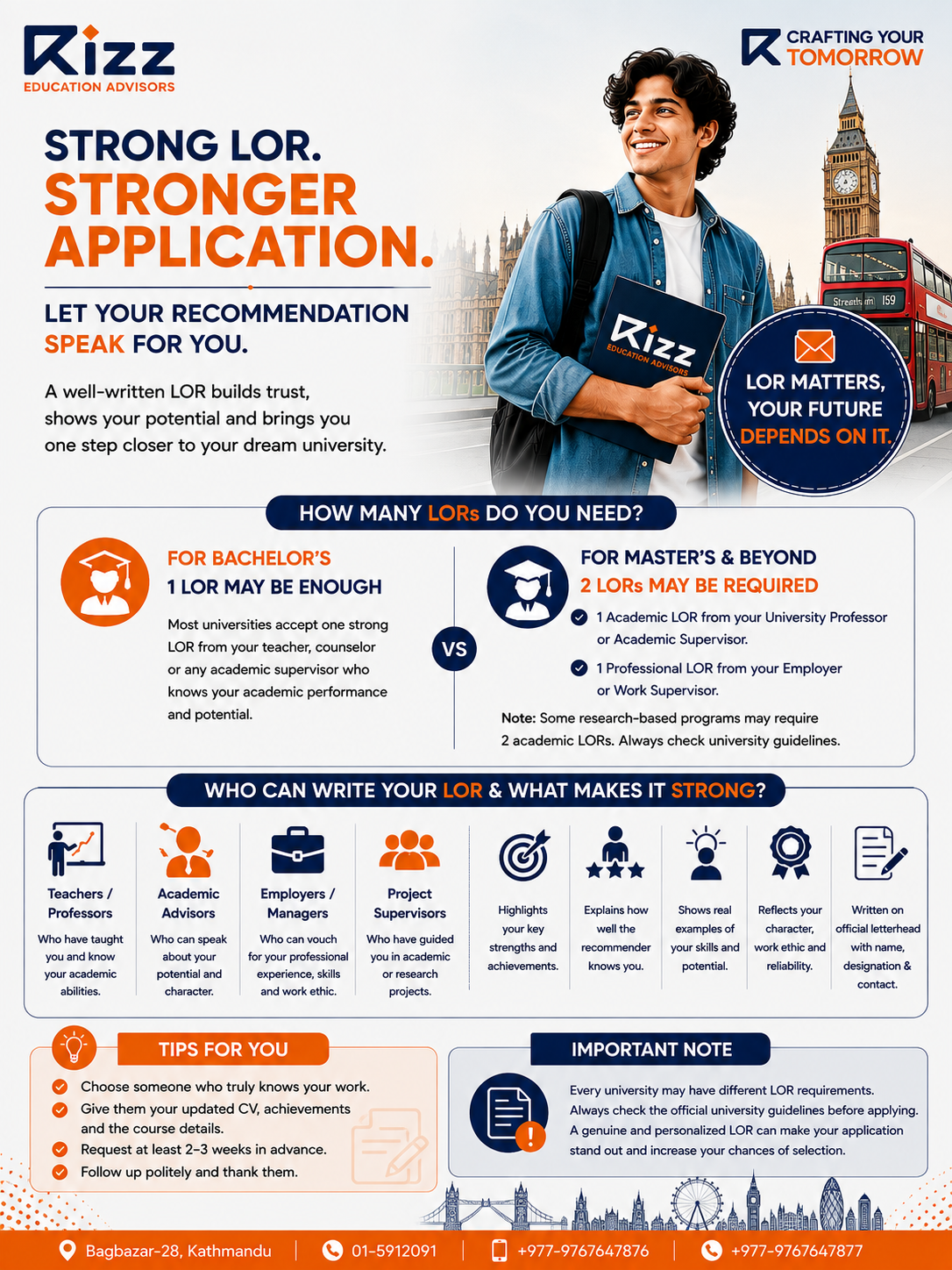
Requirements vary by level of study and by university. Here's the general pattern:
- Undergraduate (via UCAS): Usually one academic reference, typically from a school teacher or counsellor.
- Postgraduate: Usually two references — often both academic, though some programmes accept one academic plus one professional.
- Competitive institutions: Oxford, Cambridge, and Imperial College London commonly ask for two references even at undergraduate level.
Always check your specific university's requirements before requesting letters, since exceptions are common.
Academic LOR vs Professional LOR
An academic LOR comes from a professor, subject teacher, or Head of Department who taught you directly. It focuses on your coursework, research ability, and classroom performance. For example, this is the standard choice if you're applying straight from Grade 12 or your Bachelor's, with no work experience yet.
By contrast, a professional LOR comes from an employer, manager, or supervisor, and it focuses on your workplace performance, teamwork, and leadership instead. This route fits Master's applicants with relevant internship or job experience, especially for MBA and professional postgraduate programmes.
What Belongs in a Strong LOR
- Official letterhead — college, university, or company, not a plain printout.
- A formal salutation, addressed to the admissions committee or a named officer where possible.
- State the relationship clearly: how the recommender knows you, and for how long.
- Specific evaluation with real examples — a named project, a measurable improvement, a concrete achievement.
- Give a confident concluding endorsement, with the recommender's signature and contact details.
Most UK universities expect 400 to 500 words on a single page. Longer isn't stronger — specific is stronger.
Common Mistakes That Weaken a LOR
The Reality of Getting a LOR in Nepal
Many Nepali students already know the pattern: your teacher hands the drafting back to you and asks you to bring a written letter for their signature. This is common practice, not something unique to you. If this happens, use it to your advantage rather than treating it as a shortcut. Write specific, evidence-based content — name a real project, a real grade improvement, a real classroom moment — instead of generic praise. As a result, a detailed self-drafted letter your teacher approves and signs beats a vague template every time, since admissions officers evaluate content, not who physically typed it.
Your LOR for Nepalese students works alongside your MOI letter and other application documents as part of a complete UK application package. See our MOI (Medium of Instruction) Sample for UK Student Visa from Nepal for a real example of the format admissions officers expect. Once your documents are ready, plan your budget with our Calculate every details about Tuition fees, Scholarships, PreCAS Deposit of 17 university tool.
Frequently Asked Questions
How many LORs do UK universities require?
Most UK universities ask for one to two. Undergraduate applications through UCAS typically need just one academic reference. Postgraduate applications often need two — either both academic, or one academic and one professional, depending on the programme.
Can my LOR come from an employer instead of a teacher?
Yes, for postgraduate applications. If you have relevant work experience, an employer or manager can provide a professional LOR alongside or instead of an academic one. For undergraduate applications straight from school, universities generally expect an academic referee.
Can a family member or friend write my LOR?
No. UK universities do not accept personal references from friends or family, regardless of how well they know you. Your recommender must know you in an academic or professional capacity — a teacher, professor, or supervisor.
How long should a UK university LOR be?
Most UK universities expect 400 to 500 words, fitting on a single page. Some postgraduate research programmes accept longer letters, up to around 1,000 words, but shorter and specific beats longer and generic.
Not sure which of your teachers or employers would make the strongest recommender? Ask us on WhatsApp or email rizzeducation@gmail.com and we'll help you plan your full document set.