
UK Student Visa Money Requirement: What Nepali Students Need in 2026
Once your MOI letter and LOR are sorted, the next hurdle is UK student visa money. This is where strong applications often stumble. The rules aren't unclear — but the numbers are exact, and small mistakes get applications refused. Here's precisely what you need, verified directly against the current official guidance.
Unlike the MOI letter, which your college or university issues, this requirement is entirely on you and your family to prepare correctly. There's no waiver for a strong academic record or a compelling personal statement — UKVI checks this requirement mechanically, against fixed thresholds and dates. Still working through your document checklist? See our guide on how to study UK without IELTS if you haven't settled that piece yet.
How Much Money Do You Actually Need?
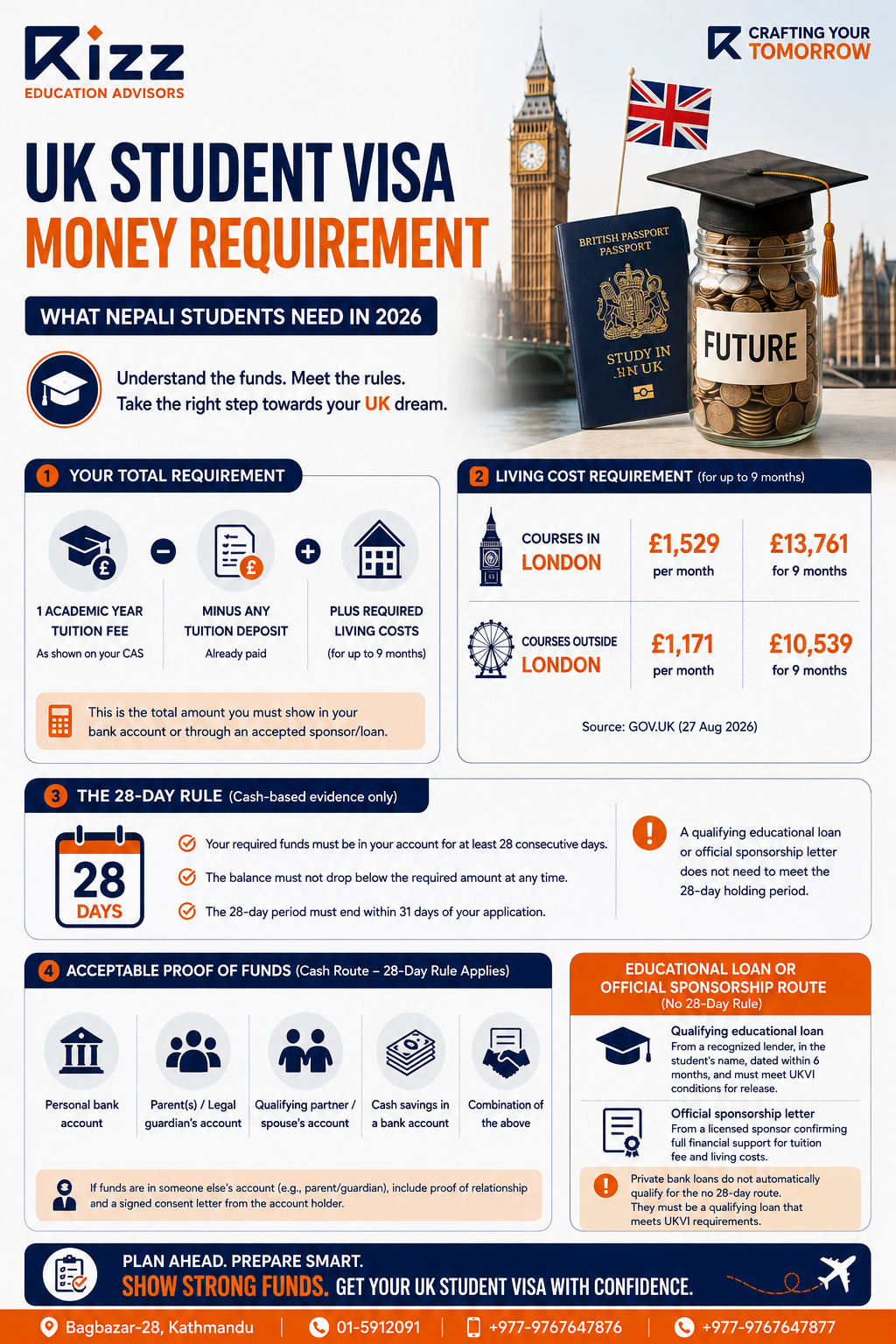
Two separate parts make up your total requirement. First, your course fee for one academic year, exactly as shown on your CAS, minus any deposit you've already paid. Choosing a lower-cost university, like several of the affordable UK university options for Nepali students, directly reduces this first number. Second, your living costs, which depend on where you'll study:
| Location | Monthly Amount | Maximum (9 months) |
|---|---|---|
| London (City of London + 32 boroughs) | £1,529 | £13,761 |
| Outside London | £1,171 | £10,539 |
Figures verified directly against gov.uk's official student visa money guidance on 27 August 2026. UKVI updates these amounts periodically, so confirm the current figure before you apply — several third-party sites we checked during research were quoting outdated numbers.
The 28-Day Rule Explained
Your funds must sit in your account for at least 28 consecutive days. It can never drop below your required amount during that window. This 28-day period must also end within 31 days of your application date.
Do Nepali Students Get Any Exemption?
No. UKVI maintains a "differential evidence requirement" list of countries whose citizens skip this step entirely — it includes nations like Australia, Japan, and the USA. Nepal is not on that list. Every Nepali applicant therefore needs full financial evidence, without shortcuts, no matter how strong the rest of the application looks.
Two genuine exemptions do exist, though neither applies to most first-time applicants. One is holding a UK visa for 12+ months already. Alternatively, you might be applying as a student union sabbatical officer.
Two Ways to Meet the Financial Requirement
UKVI accepts two genuinely different types of financial evidence, and each follows its own separate timing rule. Confusing the two is a common — and avoidable — mistake.
Route 1: Cash Held for 28 Days
This is the standard route most Nepali applicants use. A qualifying account holds your funds for the full 28-day window described above. Use one of these sources:
- A personal bank or building society statement in your own name.
- Your parent or legal guardian's account, along with evidence of your relationship and a signed consent letter confirming they're letting you use the funds for your studies.
- A partner's or spouse's account, if they're applying alongside you or already in the UK.
Whichever of these applies, the same balance and 28-day rules apply in full — there's no shortcut on timing with cash-based evidence.
Route 2: Educational Loan or Official Sponsorship
This route skips the 28-day rule entirely, but only if the loan or sponsorship meets UKVI's strict definition. Private bank loans don't qualify here. They get treated as ordinary cash instead, meaning you'd still need to transfer the funds into an account and wait the full 28 days.
A genuine educational loan must come from a government, a government-sponsored student loan company, or a regulated academic loan scheme — never a private lender. Every loan letter must:
- Be in your name only, never a parent's name.
- Be dated no more than 6 months before your visa application.
- Confirm there are no conditions on releasing the funds other than a successful visa application.
- State the loan amount and confirm funds will be available before you travel, or paid directly to your university.
An official sponsorship letter works similarly, but only counts if it comes from a recognised sponsor: a government, an international organisation, the British Council, an international company, or your own university. It needs official letterhead, dated within 6 months of your application, and must state either the exact amount covered or confirm it covers your full fees and living costs. If your sponsorship is a university scholarship, it's often already reflected directly on your CAS, so you may not need a separate letter at all.
Common Mistakes That Trigger Refusals
Once your finances are in order, you're close to a complete application. If you haven't already, see our guides to the MOI letter and the LOR for Nepalese students to finish the rest of your document set. For a full breakdown of tuition, scholarships, and total costs across 17 UK universities, try our total cost calculator.
Frequently Asked Questions
How much money do I need for a UK student visa in 2026?
You need your full course fee for one academic year, as shown on your CAS, minus any deposit already paid. On top of that, add living costs of £1,529 per month for courses in London or £1,171 per month outside London, for up to 9 months.
What is the 28-day rule for a UK student visa?
For cash-based evidence, your funds must sit in your account for at least 28 consecutive days without dropping below the required amount, with the period ending within 31 days of your application. A qualifying educational loan or official sponsorship letter does not need to meet this 28-day holding period at all.
Are Nepali students exempt from proving their finances?
No. Nepal is not on UKVI's differential evidence requirement list, so Nepali students must provide full financial evidence with every application, unlike applicants from certain other countries who are exempt.
Can I use my parent's bank account as proof of funds?
Yes, if you include evidence of your relationship to them and a signed letter of consent confirming they're letting you use the funds for your studies. It must still meet the same balance and 28-day requirements, though.
Not sure if your bank statement will meet the exact format UKVI expects? Message us on WhatsApp or email rizzeducation@gmail.com and we'll check it before you apply.