
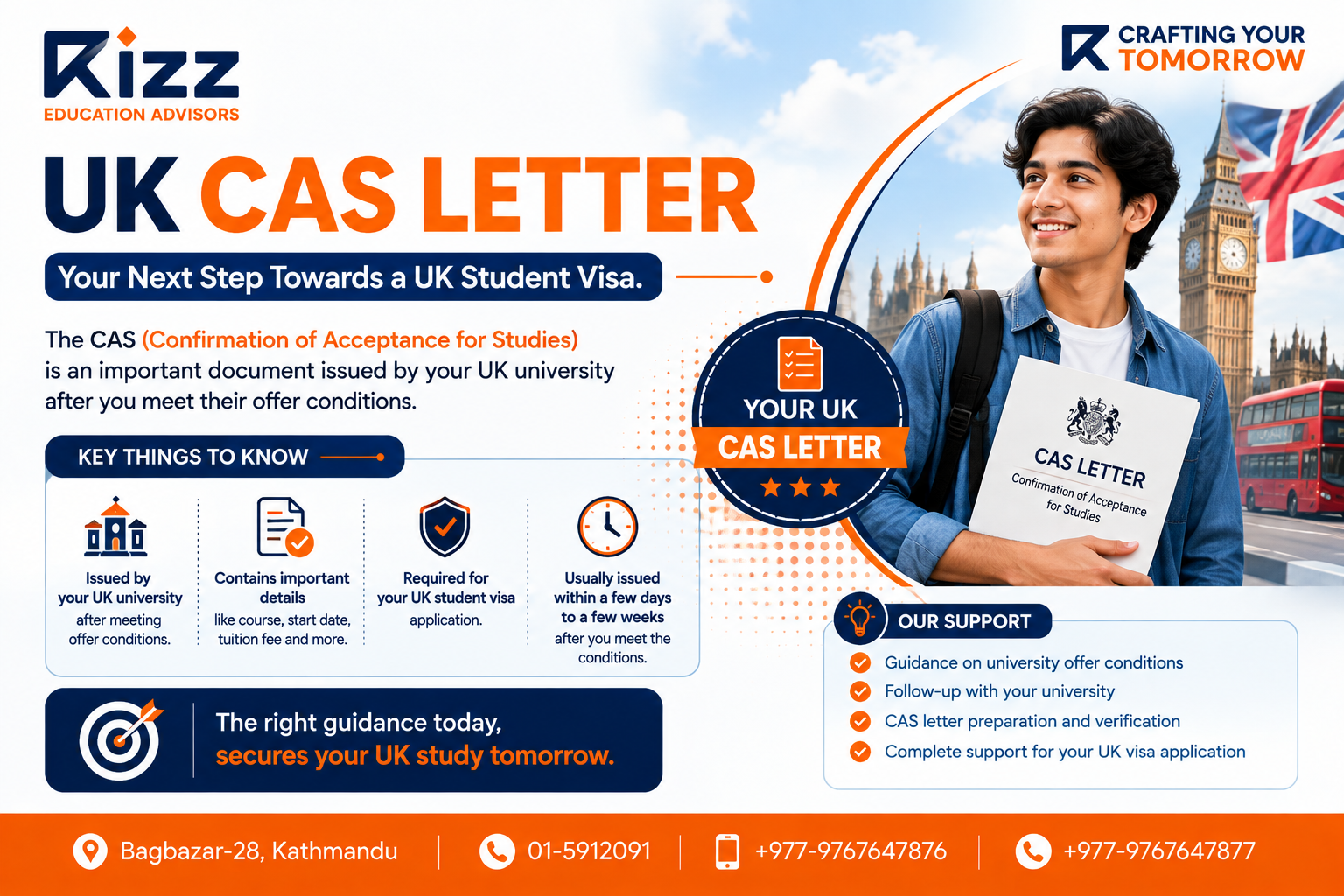
CAS Letter UK University: What It Is and How Long It Actually Takes
Once your finances, MOI letter, and LOR are ready, one document ties everything together for your visa. It's the CAS letter UK university admissions teams issue after your offer becomes unconditional. Without it, UKVI won't even look at your visa application. Here's what it actually is, realistic timelines, and the mistakes that cause delays.
What Is a CAS Letter?
CAS stands for Confirmation of Acceptance for Studies. It isn't a physical letter at all — it's an electronic record stored on UKVI's own database. Your university emails you a unique reference number and a summary statement, and that reference number is what you enter into your visa application.
A CAS confirms three things to the UK government. Your university has vetted you, accepted you onto a specific course, and agreed to sponsor your visa. Only universities holding a valid UKVI sponsor licence can issue one at all.
How Long Does It Take to Get Your CAS?
Estimates vary a lot depending on the source, and honestly, on the university itself. A realistic range:
| Timing | Typical Range |
|---|---|
| Off-peak (most of the year) | 1–3 weeks after accepting your offer and paying your deposit |
| Peak season (June–August for September intake) | 3–4 weeks or longer |
Some universities issue faster, some slower — these are general patterns, not a guarantee for your specific institution. Contact your admissions office directly if nothing arrives after 3 weeks.
What You Need Before Your University Issues It
Your university won't generate a CAS until you've cleared a few conditions:
- Accepted your unconditional offer in writing.
- Paid your required tuition deposit.
- Passed a short credibility interview, if your university requires one — expect questions about your course choice, funding, and post-graduation plans.
- Had your financial evidence pre-checked in some cases, since your CAS sets the exact financial target your visa application must meet.
If you haven't finalised your UK student visa money and bank balance yet, sort that in parallel. A poorly formatted bank statement is one of the most common reasons universities delay issuing a CAS in the first place.
CAS Validity and the 6-Month Rule
Once issued, your CAS is valid for exactly 6 months. You must submit your visa application within that window. Two rules catch people out repeatedly:
Deferring your intake also voids your current CAS. Moving from a September start to January, for example, means new course dates, so your university has to generate a fresh one from scratch.
Common CAS Mistakes to Avoid
Check your draft CAS statement the moment it arrives. A single typo in your name or passport number can trigger an automatic UKVI rejection, since your visa application must exactly mirror what's on your university's database. Never submit an application with a known error, however small, hoping it won't matter. Contact your university the same day you spot anything wrong; only they can correct it.
Once your CAS is confirmed, your document set connects fully. Your MOI letter and LOR supported your admission, and your CAS now carries that forward into your actual visa application. For UKCISA's own guidance on this process, see their official CAS explainer.
Frequently Asked Questions
How long does it take to get a CAS letter?
Most universities issue a CAS within 1 to 3 weeks of you accepting an unconditional offer and paying your deposit. During peak season (June to August for September intakes), this can stretch to 3 to 4 weeks or longer, so build in extra buffer time.
Is a CAS letter a physical document?
No. A CAS is an electronic record held on UKVI's database, not a physical letter. Your university emails you a CAS reference number and a summary statement, which you enter directly into your visa application.
Can I use the same CAS for two visa applications?
No. A CAS is single-use. If your visa application is refused, that CAS is spent and cannot be reused — your university must issue you a completely new one before you can apply again.
What happens if there's an error on my CAS?
Contact your university's admissions or visa compliance team the same day you spot it. Only your university can correct a CAS. Never submit a visa application with a known error, even a small one, since it can trigger an automatic refusal.
Not sure your CAS details match your visa application exactly? Message us on WhatsApp or email rizzeducation@gmail.com and we'll double-check it before you submit.