
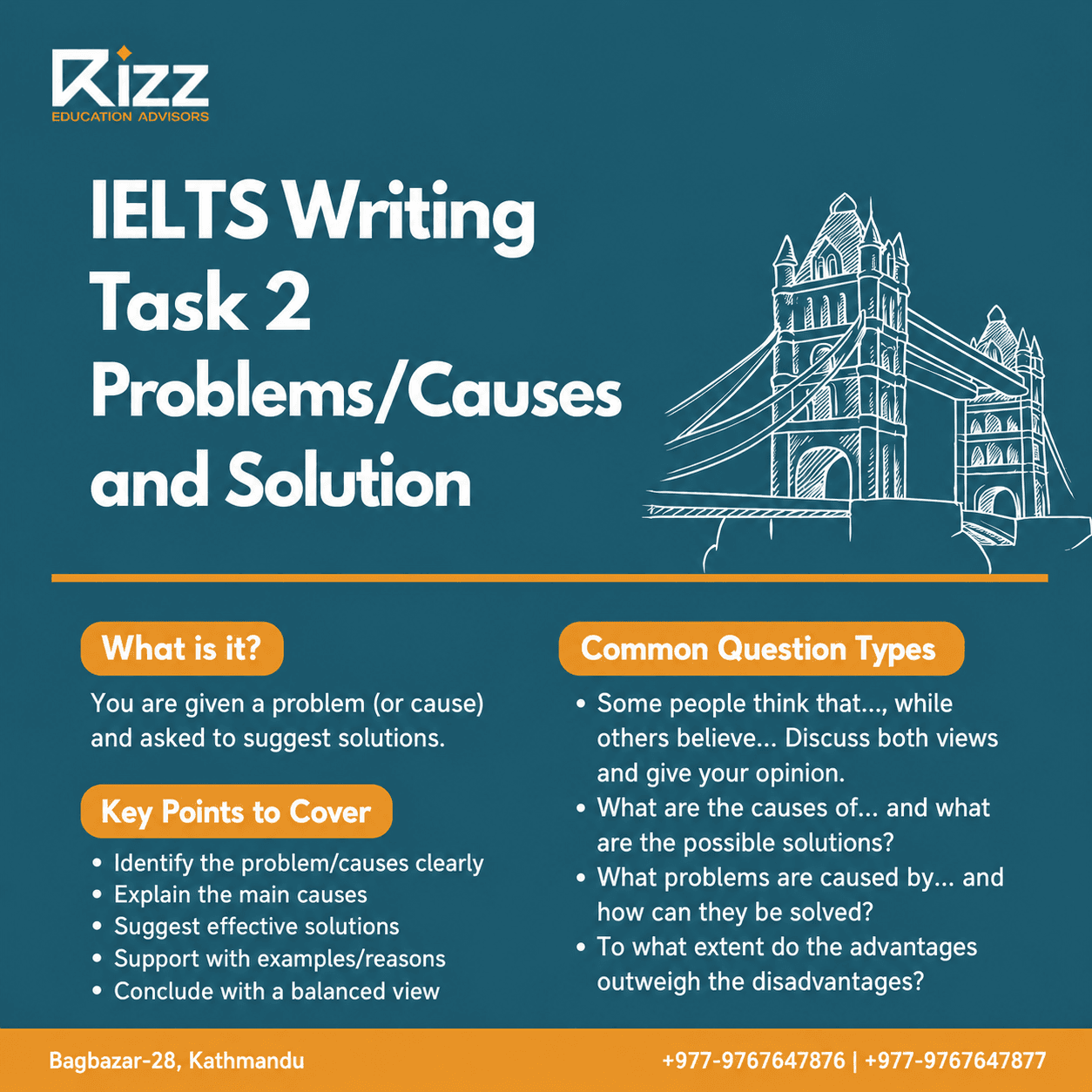
IELTS Writing Task 2 – Problems and Solutions / Causes and Solutions Complete Guide (2026)
IELTS Academic & General Training · 250 words minimum · 40 minutes · 67% of total writing band score
Key facts at a glance: 250 words minimum · 40 minutes · Worth 67% of your total writing score · Appears after Task 1 · One of the most common question types in IELTS Academic
What is a Problems and Solutions essay in IELTS Writing Task 2?
The problems and solutions essay — also called a causes and solutions essay — is one of the most common question types in IELTS Writing Task 2. It appears in roughly 15–20% of all IELTS exams. The question presents a social, environmental, or economic issue and asks you to either identify the problems it causes and suggest solutions, or identify the causes of the problem and suggest solutions.
Understanding the difference between a problems essay and a causes essay is critical — many students lose marks by answering the wrong question. Read the task carefully every time.
Problems and solutions question: "Many cities around the world are facing a housing crisis. What problems does this cause and what solutions can you suggest?"
Causes and solutions question: "Air pollution in major cities is reaching dangerous levels. What are the causes of this problem and what solutions can you suggest?"
Key difference: "problems" asks what issues the situation creates. "Causes" asks why the situation exists. The solution paragraph is required in both.
If you are also working on Task 1, our complete Writing Task 1 guide covers structure, vocabulary, and band descriptors for data-based responses. For advanced sentence structures that apply to both tasks, see our Task 1 sentence structure guide.
How to identify the question type
Before writing a single word, identify exactly what the question is asking. Look for these action words:
| Question wording | What to write | Common mistake |
|---|---|---|
| "What problems does this cause and what solutions can you suggest?" | Write about the problems the situation creates + solutions to fix them | Writing about causes instead of problems |
| "What are the causes of this problem and what solutions can you suggest?" | Write about why the problem exists + solutions to fix it | Writing about effects/consequences instead of causes |
| "What are the causes and effects of this problem?" | Write about why it exists AND what consequences it creates — no solutions needed | Adding solutions when not asked |
Essay structure — problems and solutions
A high-scoring problems and solutions essay always follows this four-paragraph structure. Aim for 260–290 words in total.
| Introduction 2–3 sentences | Paraphrase the question in your own words. State that the essay will examine the problems and propose solutions. Do not copy the question — paraphrase it using synonyms. End with a clear thesis sentence. |
| Body Paragraph 1 Problems / Causes 4–5 sentences | Present two clear problems (or causes). For each one: state it clearly, explain it in one sentence, and give a specific example or consequence. Use linking language to connect the two points (furthermore, in addition, another significant problem is). |
| Body Paragraph 2 Solutions 4–5 sentences | Propose two solutions that directly address the problems in Body Paragraph 1. For each: state the solution, explain how it works, and explain why it solves the problem. Each solution must connect clearly to a problem you raised — examiners penalise disconnected solutions. |
| Conclusion 2 sentences | Summarise the main problems and solutions in new words. Do not introduce any new ideas. A conclusion is essential — an essay without one looks unfinished and lowers your Coherence and Cohesion score. |
Important: Each solution must directly address a problem you raised in Body Paragraph 1. A common examiner complaint is "solutions seem disconnected from causes." Avoid this by planning your essay before writing — match each solution to each problem explicitly.
Sample question and band 7+ model answer
The question
In many cities around the world, traffic congestion has become a serious problem. What problems does this cause and what solutions can you suggest?
Write at least 250 words. Give reasons for your answer and include any relevant examples from your own knowledge or experience.
Model answer (band 7+)
Introduction
Traffic congestion has emerged as one of the most pressing urban challenges of the modern era, affecting millions of commuters across the globe. This essay will examine the key problems caused by this issue and propose practical solutions to address them.
Body Paragraph 1 — Problems
One major problem caused by severe traffic congestion is air pollution. When vehicles idle in slow-moving traffic for extended periods, they emit significantly higher levels of carbon dioxide and other harmful gases, contributing to deteriorating air quality. Cities such as Delhi and Beijing have recorded dangerously high pollution levels linked directly to vehicle emissions. Furthermore, traffic congestion has a considerable economic impact. Workers who spend hours stuck in traffic lose productive time, and businesses face increased costs due to delays in the delivery of goods and services. Studies have estimated that congestion costs major economies billions of dollars annually in lost productivity.
Body Paragraph 2 — Solutions
To tackle the problem of air pollution, governments could invest heavily in expanding public transport networks. If reliable, affordable, and frequent bus and rail services were available, more commuters would be encouraged to leave their private vehicles at home, thereby reducing the total number of cars on the road and cutting harmful emissions significantly. Regarding the economic cost of congestion, cities could introduce congestion charging schemes in busy urban areas. London's congestion charge, for example, has been credited with reducing traffic volumes in the city centre by approximately 30%, demonstrating that financial incentives can effectively modify commuter behaviour and ease gridlock.
Conclusion
In conclusion, traffic congestion creates serious environmental and economic problems for modern cities. However, by investing in public transport and implementing congestion pricing, governments can address both issues effectively and create more sustainable urban environments.
Examiner commentary
Task Response: Both problems are clearly identified and explained with specific examples. Both solutions directly address the problems raised — air pollution is answered by public transport, and economic cost is answered by congestion charging. This direct matching is what separates band 7 from band 6.
Coherence and Cohesion: Clear four-paragraph structure. Linking phrases used naturally — "furthermore", "regarding", "however", "thereby". The conclusion summarises without introducing new ideas.
Lexical Resource: A variety of vocabulary is used — "pressing urban challenges", "idle in slow-moving traffic", "deteriorating air quality", "modify commuter behaviour", "ease gridlock". No word is repeated excessively.
Grammatical Range and Accuracy: Mix of simple and complex sentences. Conditional structure ("if...were available"), passive voice ("have been credited"), and relative clauses ("cities such as...") demonstrate grammatical range.
Essay structure — causes and solutions
When the question asks for causes rather than problems, the structure is identical — only the focus of Body Paragraph 1 changes. Instead of writing about what the issue creates, you write about why it exists.
Sample causes and solutions question: "Air pollution in major cities is reaching dangerous levels. What are the causes of this problem and what solutions can you suggest?"
Body Paragraph 1 — Two causes:
Cause 1: The rapid increase in private vehicle ownership — as more people can afford cars, the volume of exhaust emissions in cities has risen dramatically.
Cause 2: Industrial activity and manufacturing — factories located near or within urban areas release pollutants continuously, particularly in developing nations where environmental regulations are less strict.
Body Paragraph 2 — Two solutions (matching the causes):
Solution 1 (for vehicle emissions): Governments could incentivise the adoption of electric vehicles through tax reductions and invest in expanding public transport.
Solution 2 (for industrial pollution): Stricter environmental legislation and emission caps for factories, combined with penalties for non-compliance, would force industries to adopt cleaner production methods.
Essential vocabulary for problems and solutions essays
Using a variety of academic vocabulary is essential for your Lexical Resource score. Here are the most useful phrases organised by function.
| Function | Useful phrases |
|---|---|
| Introducing problems | One major problem is · A significant issue is · This has led to · A serious consequence of this is · One of the most pressing challenges is |
| Introducing causes | One of the primary causes is · This can be attributed to · A key factor behind this is · The root cause of this problem is · This is largely due to |
| Adding a second point | Furthermore · In addition · Another significant problem is · A further cause is · Compounding this issue is |
| Introducing solutions | One effective solution would be · Governments could · A practical measure would be to · To address this problem · This could be tackled by |
| Explaining how a solution works | This would result in · By doing so · This measure would · As a result · This approach would help to |
| Concluding | In conclusion · To summarise · Overall · In summary · Taking everything into account |
| Problem/issue synonyms | issue · challenge · difficulty · concern · crisis · dilemma · obstacle |
| Solution synonyms | measure · remedy · approach · strategy · initiative · intervention · policy |
Common mistakes to avoid
Popular IELTS Writing Task 2 problems and solutions topics
These topics appear frequently in IELTS exams and are worth practising. For each one, spend 5 minutes planning two problems and two matching solutions before writing.
- Environment: Air pollution in major cities · Plastic waste in oceans · Loss of biodiversity · Climate change
- Education: Students working while studying · Lack of science students at university · Pressure on children from exams
- Health: Rising obesity rates · Mental health issues among young people · Self-medication instead of seeing doctors
- Technology: Children spending too much time on screens · Cybercrime and online fraud · Job losses due to automation
- Society: Housing crises in major cities · Traffic congestion · Ageing populations · Brain drain from developing countries
- Work: Changing working conditions · Gender pay gap · Workers unable to maintain the same job throughout their career
How Writing Task 2 is marked
Task 2 is marked on four criteria, each equally weighted. Note that Task 2 uses Task Response — not Task Achievement, which applies to Task 1.
| Criterion | What it measures | Key tip |
|---|---|---|
| Task Response | Did you answer the question fully? Did you explain your points with examples? | Answer exactly what is asked — problems OR causes, not both unless asked |
| Coherence and Cohesion | Is your essay logically organised with clear paragraphing and linking language? | Always include a conclusion — essays without one score lower |
| Lexical Resource | Do you use a wide range of vocabulary accurately and naturally? | Use synonyms for "problem" and "solution" — avoid repeating the same words |
| Grammatical Range and Accuracy | Do you use a variety of sentence structures correctly? | Mix conditionals, passives, and complex sentences with simpler ones |
Time management tip: Spend 40 minutes on Task 2. Use the first 5 minutes planning — identify your two problems/causes and match a solution to each before writing. This prevents the most common mistake of disconnected solutions and saves time during writing.
For a deeper look at sentence structures that will push your Task 2 score toward band 8, see our guide to band 9 sentence structures for Task 2. For personalised Task 2 essay feedback from a qualified IELTS trainer, book a free appointment with Rizz Education.
IELTS Writing Task 2 sample questions — problems and solutions
Practising with real exam-style questions is one of the most effective ways to prepare. Below are ten sample questions covering the most common problems and solutions topics. For each one, spend 5 minutes planning before writing your full response.
- In many cities around the world, traffic congestion has become a serious problem. What problems does this cause and what solutions can you suggest?
- Air pollution in major cities is reaching dangerous levels. What are the causes of this problem and what solutions can you suggest?
- In many countries, young people are finding it increasingly difficult to afford their own homes. What are the causes of this problem? What solutions can be offered?
- Some students work while studying. This often results in a lack of time for education and constantly feeling under pressure. What problems does this cause and what can be done to tackle them?
- Obesity rates are rising in many countries around the world. What are the causes of this problem and what measures could be taken to address it?
- Many young people in developing countries are leaving their home nations to work abroad. What problems does this cause and what solutions would you suggest?
- The internet has transformed the way information is shared and consumed, but it has also created problems that did not exist before. What are some of these problems and how can they be solved?
- In many parts of the world, the amount of waste produced by households is increasing. What are the causes of this problem and what solutions can you suggest?
- Despite health warnings, a large number of people continue to smoke. Why should we be concerned about this and what solutions would you suggest?
- Many older people in developed countries are living alone. What problems does this cause for the individual and for society, and what solutions can you suggest?
Practice tip: For each question above, write your plan first — two problems/causes in one column and two matching solutions in the other. Only start writing when your plan is complete. This 5-minute investment prevents the most common Task 2 mistake of disconnected solutions.
IELTS Writing Task 2 sample answer band 8 — problems and solutions
The band 8 response below answers the question about young people and housing affordability. Notice how it uses more sophisticated vocabulary, a wider range of grammatical structures, and more precise explanations compared to a band 7 response.
Question
In many countries, young people are finding it increasingly difficult to afford their own homes. What are the causes of this problem? What solutions can be offered?
Band 8 Model Answer
The inability of younger generations to purchase property has emerged as a significant socioeconomic challenge across much of the developed and developing world. This essay will examine the principal causes of this trend and propose viable solutions to address it.
A primary cause of housing unaffordability is the sharp and sustained increase in property prices relative to wage growth. Over recent decades, real estate values in major cities have risen dramatically, driven largely by speculative investment and limited housing supply, while salaries — particularly for entry-level workers — have failed to keep pace. A young professional in cities such as London, Sydney, or Kathmandu may need to save for a decade or more simply to accumulate a sufficient deposit. Compounding this issue is the widespread use of short-term employment contracts, which makes it considerably harder for young people to secure mortgage approval from lending institutions, as banks typically require proof of stable, long-term income.
To tackle the affordability crisis, governments could introduce targeted housing assistance schemes for first-time buyers, such as subsidised deposit loans or shared-ownership programmes. Such initiatives would lower the financial barrier to entry without requiring a complete overhaul of the property market. Regarding employment instability, policymakers could introduce stronger regulations protecting workers on temporary contracts, ensuring they receive greater financial security and are better positioned to meet mortgage eligibility criteria. Countries such as Germany, where tenant protections are robust and social housing is widely available, demonstrate that proactive government intervention can meaningfully improve housing accessibility for younger citizens.
In conclusion, rising property prices and precarious employment conditions are the two most significant barriers preventing young people from owning homes. Targeted financial assistance and stronger employment protections offer practical pathways to address both causes effectively.
Why this scores band 8
- Task Response: Both causes are fully developed with detailed explanations — not just stated but explained precisely. Both solutions match the causes directly.
- Lexical Resource: Sophisticated vocabulary throughout — "socioeconomic challenge", "speculative investment", "mortgage eligibility criteria", "proactive government intervention". No word is repeated unnecessarily.
- Grammar: Wide range of structures — "having failed to keep pace", relative clauses, passive voice, conditional structures, and a real-world example integrated naturally.
- Coherence: "Compounding this issue" links the two causes seamlessly. "Regarding employment instability" signals the move to the second solution cleanly.
IELTS Writing Task 2 sample answer band 9 — problems and solutions
A band 9 response demonstrates full flexibility and accuracy in both vocabulary and grammar, with ideas that are thoroughly developed and precisely expressed. The response below answers the question on household waste.
Question
In many parts of the world, the amount of waste produced by households is increasing. What are the causes of this problem and what solutions can you suggest?
Band 9 Model Answer
Rising household waste is a global environmental concern that shows little sign of abating despite growing public awareness of its consequences. This essay will explore the underlying causes of this trend and put forward practical measures to reverse it.
The most significant driver of increasing household waste is the proliferation of single-use packaging in the consumer goods industry. As convenience culture has taken hold across both developed and developing nations, manufacturers have come to rely heavily on disposable plastics, cardboard, and polystyrene to package everything from food to electronics. The vast majority of this material is discarded immediately after purchase, overwhelming municipal waste management systems. A further cause is the culture of planned obsolescence embedded in modern consumer electronics and fast fashion, which encourages individuals to replace still-functional items with newer models at an ever-increasing rate, generating substantial volumes of solid waste that are difficult or impossible to recycle.
To address the packaging problem, governments could introduce extended producer responsibility legislation, compelling manufacturers to take financial responsibility for the collection and recycling of their own packaging materials. This would create a powerful economic incentive for companies to reduce unnecessary packaging at source rather than passing the environmental cost onto consumers and local authorities. With regard to planned obsolescence, stricter regulations requiring manufacturers to guarantee spare part availability and repairability for a minimum of ten years — a policy already piloted within the European Union — would significantly extend product lifespans and reduce the volume of prematurely discarded goods entering the waste stream.
In conclusion, excessive packaging and a throwaway consumer culture are the principal causes of rising household waste. Legislative action targeting manufacturers, rather than individual consumers, represents the most impactful and sustainable path to reducing waste at scale.
Why this scores band 9
- Task Response: Both causes are original, specific, and fully explained. Both solutions are precise legislative measures that match the causes exactly — not vague suggestions.
- Lexical Resource: Precise, sophisticated vocabulary used naturally — "planned obsolescence", "extended producer responsibility", "proliferation", "polystyrene", "municipal waste management". No errors.
- Grammar: Full range of structures with no errors — reduced relative clauses, passive voice, nominalisations ("the proliferation of"), conditional structures, and real-world policy examples.
- Coherence: "A further cause is", "with regard to", and "rather than" all used precisely. The conclusion introduces a fresh analytical point ("targeting manufacturers rather than consumers") without adding new information.
What is the difference between band 7, band 8, and band 9 in Task 2?
| Band | Task Response | Vocabulary | Grammar |
|---|---|---|---|
| Band 7 | All parts of the task addressed. Ideas clear and relevant but not always fully developed | Sufficient range with some flexibility. Occasional inaccuracies but meaning always clear | Variety of complex structures. Some errors but they do not impede understanding |
| Band 8 | All parts well covered with well-developed ideas. Position is clear throughout | Wide range used with flexibility and precision. Rare minor errors only | Wide range of structures used accurately and flexibly. Very rare minor errors |
| Band 9 | Fully addresses all requirements with original, precise ideas and examples | Full flexibility and precision. Vocabulary used naturally with no errors | Full range of structures with complete accuracy throughout |
For a deeper look at sentence structures that will push your Task 2 score toward band 8 and 9, see our guide to band 9 sentence structures for Task 2. For personalised Task 2 essay feedback from a qualified IELTS trainer, book a free appointment with Rizz Education.